
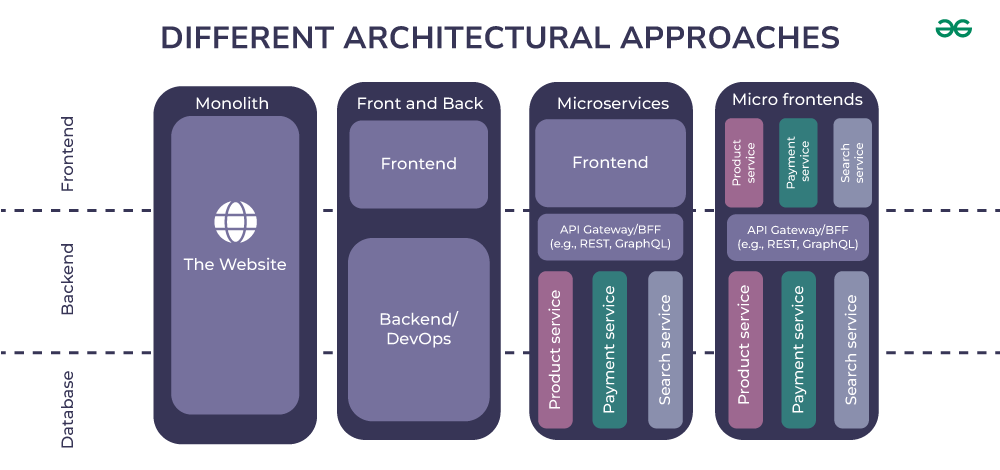
There is no doubt that creating and building a large, complex web application is no less than a challenge. As codebases grow, development slows down. Moreover deployments become riskier and teams start stepping on each other’s toes. We call this problem frontend monolith. The solution to this problem is Micro frontend architecture. Basically it is an innovative approach that borrows ideas from microservices for the transformation of the idea as to how we build user interfaces. Do you wish to learn more about it? If yes, then keep on reading.
Defining Micro Frontend Architecture
It is an architectural style. This basically breaks down a single, large frontend application into smaller and independent deliverable units. For example: There is an e-commerce website. On this website you can create separate micro frontends like The product listing, shopping cart, user profile and more. Different members or teams can own and manage these frontends. The final user experience will still appear as a single, cohesive application.
Key Benefits
When you adopt micro frontend architecture style it offers multiple advantages:
✓ Independent Deployment
Teams can easily deploy their specific micro frontend on its own schedule. They do not need to hold on for the others to finish. This amps up the overall performance and also speeds up the release cycle. Basically with faster deployments, features get to users soon.
✓ Technology Flexibility
Each microfrontend can make use of its own technology stack. For eg: one team can use React, while the other one can use Angular or Vue.js. Further, they can easily upgrade their technology without having to ask for a change across the entire application.
✓ Simplification
Smaller codebases are quite easy to understand and manage. Because the micro frontend only contains the code for its specific feature. This minimizes the load for the developers and also makes it easy to find and fix bugs.
✓ Scalability
Micro frontend architecture allows you to create smaller autonomous teams. Each team owns its components from end to end, that is from development to deployment. This reduces team dependency and thus allows them to boost overall productivity and scalability.
Implementing Micro Frontend Architecture
Implementation of micro frontend architecture needs careful planning. The integration of each end must be seamless and proper. There are several integration approaches. A “shell” application loads micro frontends at runtime in the user’s browser. For this, tools like Webpack 5’s Module Federation are popular. Up next, micro frontends can be packed as native Web Components. They provide a standard way to create custom and reusable HTML elements. Thereafter with routing the main application routes traffic to different full page micro frontends based on the URL. This is much more simple but it offers fine-grained control.
Best Practices
You can follow these below written simple guidelines to succeed with micro frontend architecture:
- Each micro frontend must have a single and clear responsibility. So basically you must define clear boundaries and avoid overlapping functionality.
- Secondly, maintain a design system. This ensures a consistent look as well as feel across all components.
- Thereafter, manage communication properly. Minimize direct communication and use simple methods like native browser events for crucial data sharing.
- Finally, carefully manage shared libraries like React. This prevents loading the same code multiple times.
Concluding Remarks!
Micro frontends are not a universal solution. They are best for large scale applications that have multiple features and for environments where quick and frequent deployments are crucial. So if you are an organization who is looking for building a complex, scalable user interface then you can surely take the help from us. We are just a call away. We look forward to serving you.
